



Gideon Reuveni, Reinhard Schweitzer
2026.
More information | Abstract | Links:
@workshop{nokey,

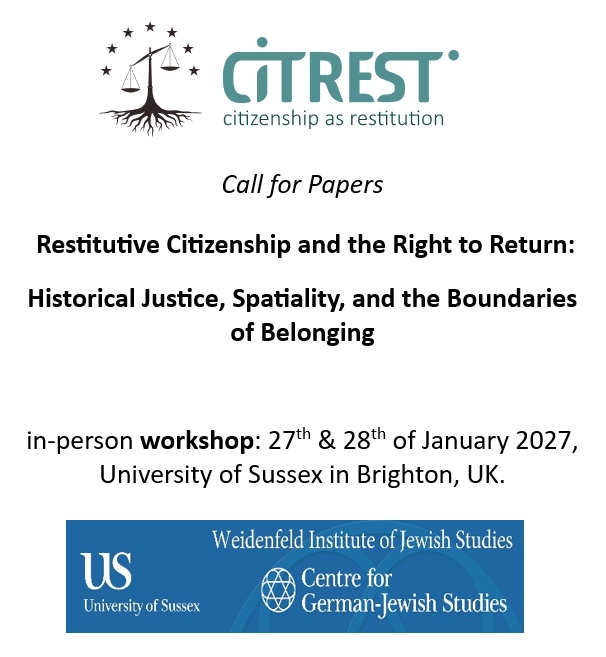
title = {Call for Papers: Restitutive Citizenship and the Right to Return: Historical Justice, Spatiality, and the Boundaries of Belonging},

author = {Gideon Reuveni, Reinhard Schweitzer},

url = {https://citrest.es/wp-content/uploads/2026/07/CfP_Restitutive-Citizenship-and-the-Right-to-Return_final.pdf},

year  = {2026},

date = {2026-07-29},

urldate = {2026-07-29},

abstract = {The relationship between state sovereignty, historical justice, and territorial belonging remains one of the most contested questions in contemporary legal and political scholarship. As borders shift, conflicts displace millions, and post-communist and post-colonial states continue to redefine their political communities, renewed attention is needed to the relationship between restitutive or reparative citizenship and the right of return.


This workshop invites papers that examine the theoretical, legal, historical, and empirical intersections between the restoration of citizenship and territorial return. While international human rights and refugee law have long sought to protect the right of displaced persons to return to their homes or countries of origin, many contemporary citizenship restoration policies operate in increasingly extraterritorial, non-residential, and symbolic registers. They often restore formal status without necessarily enabling physical return, property restitution, or renewed political membership in a substantive sense.


A central aim of the workshop is to explore the conceptual distinction between restitution and reparation in relation to citizenship. Restitution refers to the restoration of a status or right unjustly denied to individuals themselves, for example in cases of denationalisation, exile, or statelessness. Reparation, by contrast, often addresses historical wrongs across generations, particularly where direct restitution is no longer possible. While reparative citizenship can perform an important expressive function by acknowledging past injustice and assuming state responsibility, it may also raise difficult questions about belonging, intergenerational entitlement, territorial connection, and the “genuine link” between individuals and states. In addition, reparative citizenship offers often target or effectively benefit certain groups more than others and can thereby reproduce existing inequalities in terms of access to legal recognition, property restitution, political participation, and territorial belonging.},

keywords = {},

pubstate = {published},

tppubtype = {workshop}

}
The relationship between state sovereignty, historical justice, and territorial belonging remains one of the most contested questions in contemporary legal and political scholarship. As borders shift, conflicts displace millions, and post-communist and post-colonial states continue to redefine their political communities, renewed attention is needed to the relationship between restitutive or reparative citizenship and the right of return.
This workshop invites papers that examine the theoretical, legal, historical, and empirical intersections between the restoration of citizenship and territorial return. While international human rights and refugee law have long sought to protect the right of displaced persons to return to their homes or countries of origin, many contemporary citizenship restoration policies operate in increasingly extraterritorial, non-residential, and symbolic registers. They often restore formal status without necessarily enabling physical return, property restitution, or renewed political membership in a substantive sense.
A central aim of the workshop is to explore the conceptual distinction between restitution and reparation in relation to citizenship. Restitution refers to the restoration of a status or right unjustly denied to individuals themselves, for example in cases of denationalisation, exile, or statelessness. Reparation, by contrast, often addresses historical wrongs across generations, particularly where direct restitution is no longer possible. While reparative citizenship can perform an important expressive function by acknowledging past injustice and assuming state responsibility, it may also raise difficult questions about belonging, intergenerational entitlement, territorial connection, and the “genuine link” between individuals and states. In addition, reparative citizenship offers often target or effectively benefit certain groups more than others and can thereby reproduce existing inequalities in terms of access to legal recognition, property restitution, political participation, and territorial belonging.
This workshop invites papers that examine the theoretical, legal, historical, and empirical intersections between the restoration of citizenship and territorial return. While international human rights and refugee law have long sought to protect the right of displaced persons to return to their homes or countries of origin, many contemporary citizenship restoration policies operate in increasingly extraterritorial, non-residential, and symbolic registers. They often restore formal status without necessarily enabling physical return, property restitution, or renewed political membership in a substantive sense.
A central aim of the workshop is to explore the conceptual distinction between restitution and reparation in relation to citizenship. Restitution refers to the restoration of a status or right unjustly denied to individuals themselves, for example in cases of denationalisation, exile, or statelessness. Reparation, by contrast, often addresses historical wrongs across generations, particularly where direct restitution is no longer possible. While reparative citizenship can perform an important expressive function by acknowledging past injustice and assuming state responsibility, it may also raise difficult questions about belonging, intergenerational entitlement, territorial connection, and the “genuine link” between individuals and states. In addition, reparative citizenship offers often target or effectively benefit certain groups more than others and can thereby reproduce existing inequalities in terms of access to legal recognition, property restitution, political participation, and territorial belonging.
Reinhard Schweitzer
Ancestral Citizenship as Restitution, Or Selective Immigration Policy? Working paper
2025.
Abstract | Links:
@workingpaper{nokey,

title = {Ancestral Citizenship as Restitution, Or Selective Immigration Policy? },

author = {Reinhard Schweitzer},

url = {https://citrest.es/wp-content/uploads/2025/05/WP1_FINAL_May2025.pdf, Download PDF},

year  = {2025},

date = {2025-05-19},

urldate = {2025-05-19},

issue = {CITREST Working Paper 1},

abstract = {Like several other EU Member States, Austria and Spain have recently opened privileged pathways to external citizenship for descendants of the many people who had fled persecution under previous authoritarian regimes. Ancestral citizenship not only offers mobility and other key rights and opportunities for individual beneficiaries (as well as their children) but also fulfils a range of purposes for the nation-state that grants it, including intergenerational continuity and territorial or at least symbolic inclusion of people with familial ties to that state. This can be part of a necessarily complex and long-term process through which modern nation-states (and their populations) are trying to come to terms with their uncomfortable past. But it can also be seen as a tool for managing the future composition of a country’s population and thus function as an ethnically selective complement or even substitute for immigration policy. Based on a comparative analysis of legal documents, media coverage, and political debates around these two reforms and their ongoing implementation, this paper highlights the similarities and key differences between the Austrian and Spanish cases, questions some of the underlying interests, intentions, and official justifications, and thereby helps to explain how and why these reforms have come about. This analysis constitutes the first step of a multi-annual research project funded by the Spanish Ministry of Science that aims to contribute to a better understanding of, and more informed public and political debates about, the role of ancestral citizenship in and for contemporary Europe.},

keywords = {},

pubstate = {published},

tppubtype = {workingpaper}

}
Like several other EU Member States, Austria and Spain have recently opened privileged pathways to external citizenship for descendants of the many people who had fled persecution under previous authoritarian regimes. Ancestral citizenship not only offers mobility and other key rights and opportunities for individual beneficiaries (as well as their children) but also fulfils a range of purposes for the nation-state that grants it, including intergenerational continuity and territorial or at least symbolic inclusion of people with familial ties to that state. This can be part of a necessarily complex and long-term process through which modern nation-states (and their populations) are trying to come to terms with their uncomfortable past. But it can also be seen as a tool for managing the future composition of a country’s population and thus function as an ethnically selective complement or even substitute for immigration policy. Based on a comparative analysis of legal documents, media coverage, and political debates around these two reforms and their ongoing implementation, this paper highlights the similarities and key differences between the Austrian and Spanish cases, questions some of the underlying interests, intentions, and official justifications, and thereby helps to explain how and why these reforms have come about. This analysis constitutes the first step of a multi-annual research project funded by the Spanish Ministry of Science that aims to contribute to a better understanding of, and more informed public and political debates about, the role of ancestral citizenship in and for contemporary Europe.
Francesco Pasetti, Reinhard Schweitzer
Looking back and abroad while (not) moving forward. Migration, ideas and the stability of citizenship in Spain. Journal Article
In: Frontiers in Sociology (online first), 2025.
More information | Abstract | Links:
Open Access. Published in Frontiers in Sociology, as part of the Special Issue “The Citizenship of International Migrants: Rethinking the Migration-Citizenship Nexus Today”. Edited by Salvatore Strozza, Rosa Gatti, Gianni D'Amato, and Margit Fauser.
@article{nokey,

title = {Looking back and abroad while (not) moving forward. Migration, ideas and the stability of citizenship in Spain.},

author = {Francesco Pasetti and Reinhard Schweitzer},

editor = {Salvatore Strozza and Rosa Gatti and Gianni D'Amato and Margit Fauser},

url = {https://doi.org/10.3389/fsoc.2025.1570110, Full-Text Access

https://citrest.es/wp-content/uploads/2025/07/PasettiSchweitzer2025_Looking-back-and-abroad-while-not-moving-forward.pdf, Download PDF

https://www.frontiersin.org/research-topics/62947/the-citizenship-of-international-migrants-rethinking-the-migration-citizenship-nexus-today/, Access the Special Issue


},

doi = {10.3389/fsoc.2025.1570110},

year  = {2025},

date = {2025-07-03},

urldate = {2025-07-03},

journal = {Frontiers in Sociology (online first)},

abstract = {This article addresses the remarkable stability of the Spanish citizenship regime. Since it was established in 1982, it has remained largely unchanged, despite the country's rapid transformation from a country of emigration to a major destination for non-EU immigrants. We complement existing explanations for this phenomenon by shifting the analytical focus to the realm of ideas. Based on a close analysis of the law-making process and parliamentary debates about citizenship reforms between 1978 and 2024, we argue that this puzzling stability can partly be attributed to the widely shared and remarkably stable way in which the country's political elite conceives nationality. We identify three constitutive elements that make this dominant citizenship frame: (i) the preference for blood-ties over territorial presence, (ii) the preferential treatment of emigrants (and their descendants) over immigrants, and (iii) the predilection for potential citizens' historical over contemporary connections to Spain. This set of ideas, in which political parties' views overlap, has constituted the tracks along which the country's nationality laws have evolved. It has outlived not only demographic but also political changes including the appearance of the country's first far-right, anti-immigrant party. By focusing on ideas, this article offers a new analytical and less deterministic perspective, complementing the explanatory backdrop provided to date by the scholarship concerned with citizenship law-making. Our findings and analysis contribute to a fuller understanding of the politics of citizenship in Spain and—more generally—of the ambiguous role that past, present, and future migratory dynamics (can) play in shaping—the evolution of citizenship law-making. It thereby also contributes to the literature on the multifaceted nexus between citizenship and migration and to broader debates on the importance of ideas in public policymaking.},

keywords = {},

pubstate = {published},

tppubtype = {article}

}
This article addresses the remarkable stability of the Spanish citizenship regime. Since it was established in 1982, it has remained largely unchanged, despite the country's rapid transformation from a country of emigration to a major destination for non-EU immigrants. We complement existing explanations for this phenomenon by shifting the analytical focus to the realm of ideas. Based on a close analysis of the law-making process and parliamentary debates about citizenship reforms between 1978 and 2024, we argue that this puzzling stability can partly be attributed to the widely shared and remarkably stable way in which the country's political elite conceives nationality. We identify three constitutive elements that make this dominant citizenship frame: (i) the preference for blood-ties over territorial presence, (ii) the preferential treatment of emigrants (and their descendants) over immigrants, and (iii) the predilection for potential citizens' historical over contemporary connections to Spain. This set of ideas, in which political parties' views overlap, has constituted the tracks along which the country's nationality laws have evolved. It has outlived not only demographic but also political changes including the appearance of the country's first far-right, anti-immigrant party. By focusing on ideas, this article offers a new analytical and less deterministic perspective, complementing the explanatory backdrop provided to date by the scholarship concerned with citizenship law-making. Our findings and analysis contribute to a fuller understanding of the politics of citizenship in Spain and—more generally—of the ambiguous role that past, present, and future migratory dynamics (can) play in shaping—the evolution of citizenship law-making. It thereby also contributes to the literature on the multifaceted nexus between citizenship and migration and to broader debates on the importance of ideas in public policymaking.
Reinhard Schweitzer, Tina Magazzini
Citizenship Restitution as (Disguised) Selective Immigration Policy Online
David Owen, Rainer Bauböck (Ed.): 2025, visited: 16.05.2025.
More information | Abstract | Links:
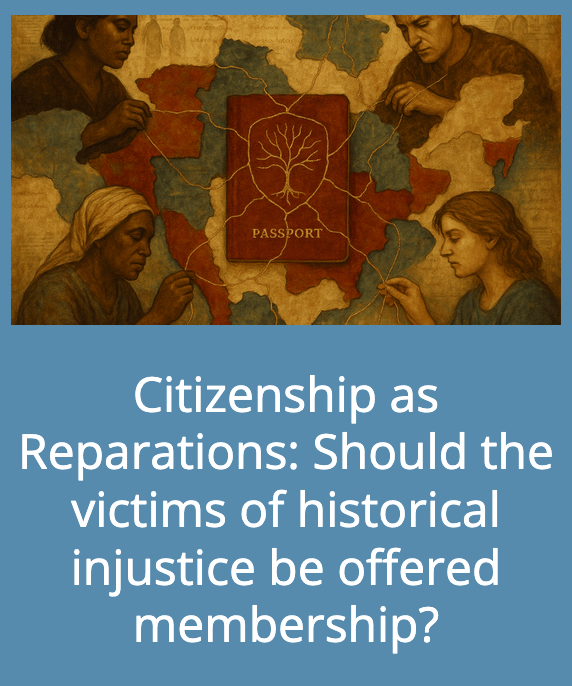
Invited contribution to the GLOBALCIT Forum “Citizenship as Reparations: Should the victims of historical injustice be offered membership?”
Global Citizenship Observatory, Robert Schuman Centre, European University Institute. Visit: https://globalcit.eu/
Global Citizenship Observatory, Robert Schuman Centre, European University Institute. Visit: https://globalcit.eu/
@online{nokey,

title = {Citizenship Restitution as (Disguised) Selective Immigration Policy},

author = {Reinhard Schweitzer and Tina Magazzini},

editor = {David Owen and Rainer Bauböck},

url = {https://globalcit.eu/citizenship-as-reparations-should-the-victims-of-historical-injustice-be-offered-membership/9/, Read online},

year  = {2025},

date = {2025-05-16},

urldate = {2025-05-16},

institution = {Global Citizenship Observatory, Robert Schuman Centre, European University Institute.},

abstract = {The central question posed by David Owen and Rainer Bauböck in the kickoff for this forum is whether citizenship is an appropriate form of reparation for historical injustice, and whether it should be offered not only to the victims themselves but also their descendants. The very varied and nuanced responses that their piece has triggered so far suggest that it is difficult to answer this question with a simple yes or no. In our contribution to this debate, we want to take a step back and ask whether the states that are framing citizenship offers in terms of reparation might instead – or in addition – be trying to attract desirable immigrants.},

keywords = {},

pubstate = {published},

tppubtype = {online}

}
The central question posed by David Owen and Rainer Bauböck in the kickoff for this forum is whether citizenship is an appropriate form of reparation for historical injustice, and whether it should be offered not only to the victims themselves but also their descendants. The very varied and nuanced responses that their piece has triggered so far suggest that it is difficult to answer this question with a simple yes or no. In our contribution to this debate, we want to take a step back and ask whether the states that are framing citizenship offers in terms of reparation might instead – or in addition – be trying to attract desirable immigrants.


The workshop will be in-person and take place on the 27th and 28th of January 2027, at the University of Sussex in Brighton, UK.
Limited funding will be available to cover at least part of the travel and accommodation costs of participants based in Europe and the United Kingdom. Applications from participants based outside Europe are of course also welcome, but they will normally be expected to cover their own travel expenses.
Submission details:
Please send an abstract of approximately 200 words and a short biographical note to G.Reuveni@sussex.ac.uk and rschweitzer@uao.es, by the 30th of September 2026.
Selected participants will be notified by the end of October.
Selected papers may also be considered for inclusion in a special issue or edited volume.
Close